
 Posts


Thank you to Marc Leibowitz for bringing to my attention this exchange on the Atlantic blog, following up on an Op-Ed in the Washington Post about how we view women clergy.
I will add my limited wisdom here:
First of all, on the other side, I cannot tell you how many times (with different congregations), I have heard the story of the religious school child who asked the question, "Boys can grow up to be rabbis, too?".
I am only too grateful for the pioneering women who became rabbis, paving the way for a more gender inclusive Judaism, as well as chevre for me as a Reform Rabbi. While there are still many things that still need to be fixed (pay equity, for one), there is no way that I could enumerate all the benefits of having Rabbi Regina Jonas (z'l), Rabbi Sally Preisand, and my friends Rabbi Shira Stern, Rabbi Julie Wolkoff, and Rabbi Sue Levi-Elwell (to name just a few) to pave the way so that I could have so many female rabbis as mentors, models, and colleagues.
I will add that I am not one who fears the "feminization of the rabbinate" or feels the need for men to recapture Jewish ritual, the bimah, or the leadership of the Reform movement (still overwhelmingly led by men).
Comortable? After all, Rabbi Abraham Joshua Heschel (supposedly) said that is a rabbi's job to “comfort the afflicted and afflict the comfortable".
21 December 2012


17 December 2012
HaKotel, The Western Wall
Dear Prime Minister Netanyahu,
Temple Sholom of Scotch Plains/Fanwood, NJ
(908) 889-4900
"The more Torah, the more life" - Hillel
I regularly subscribe to the Israeli Ministry of Foreign Affairs webblast, and so I read with interest the Cabinet Communique from yesterday morning (16 December 2012). The headline quoted you as follows:
PM Netanyahu: The Western Wall symbolizes the foundation of our existence here for thousands of years. We will stand steadfast in the face of all those who want to expel us from here. The State of Israel, Jerusalem and the Western Wall will remain ours forever.
In this hope and commitment, I agree with you one-hundred percent. Yet, I find it ironic that you made this statement about lighting a menorah at the Western Wall (haKotel), in the very same week that a new ordinance has prohibited women from bringing ritual objects to that site. Golda Meir, or any other future female Israeli PM, would be unable to complete that same action, according to the latest regulation.
When I read your statement, I would like to interpret the "we" to include not only myself - a male, but also my colleague, Rabbi Elyse Frishman, who was detained (along with three other women) at the Kotel on this past Friday for attempting to pray with Nashot haKotel on Rosh Chodesh Tevet. (http://www.jta.org/news/article/2012/12/16/3114626/women-detained-at-western-wall-for-entering-with-prayer-shawls)
Rabbi Frishman shared a powerful statement with her congregation, which you may not be aware of (http://www.arza.org/Articles/index.cfm?id=2456) and which I am sharing with my congregation, along with this letter.
Please know, Prime Minister, that my congregation is a strong supporter of the State of Israel, and an equally strong supporter of the rights of ALL Jews to feel at home in our homeland. We, too, "will stand steadfast in the face of all those who want to expel us from here" and we hope that we will all be able to stand that way together, in person, and soon.
Thank you, and Chodesh Tov,
Rabbi Joel N. Abraham
-----------
Rabbi Joel N. AbrahamTemple Sholom of Scotch Plains/Fanwood, NJ
(908) 889-4900
"The more Torah, the more life" - Hillel
18 December 2011
Temple Sholom of Scotch Plains/Fanwood, NJ - 8th Grade - L'Atid Lavo Future of Reform Judaism Resolution 2011
We, the next generation of Reform Judaism, in order to build upon our current religious practices realize that we must take the old and turn it into something new and relevant while keeping the general values and ideas of the Reform movement alive.
For our services, we agree we should keep Hebrew due to the overall connection to other Jews and lack of direct translation. But we should incorporate the vernacular language so everyone fully understands our prayers.
As long as our congregation engages in the words of Torah, it doesn't matter how we engage as long as we do because Torah brings forth many of our morals. We support Torah forever being translated differently.
Mitzvot are always going to be a part of Jewish life. As times change, so do mitzvot. As Jews, we feel that it is important to carry on the tradition of mitzvot.
THEREFORE:
We commit ourselves to continuing our Jewish education.
We are committed to educating younger generations on the traditions and values of Judaism as a whole.
We are committed to using Jewish morals in our everyday lives to set an example for all others to follow.
We are committed to looking for as many mitzvot in our daily lives as possible no matter how big or small.
signed this 18 of December 2011, in class assembled, while participating long-distance in the URJ Biennial plenary:
Ethan Lyte
Jordan Cooke
Tori Sciara
Elizabeth Smith
Isaac Amador
Harry Wachtel
Zachary Fechtner
Cassandra Teschner
Jamie Abar
Dylan Abar
Sydney Brown
Matthew Baker
Eva Isaacs
Alex Frier
12 September 2011
Is there a difference between empowerment and DIY Judaism?
I want to, with 3 cautions, recommend an article by Jay Michaelson in the Jewish Daily Forward ("Don't Call the Rabbi, Make Your Own Rituals" - 9/8/11). Reform Judaism is based on the idea of informed choice - so the more that you are empowered and educated in your own Judaism the better. I am proud that we are studying the lifecycle throughout the congregation for this trimester, and the evidence of understanding for our Sunday program students will be to create a lifecycle ritual together as a class.
The first caution is - PLEASE call the Rabbi. Ask any couple or family with whom I have created a lifecycle ritual. We work together to create appropriate and meaningful Jewish rituals. The first thing that I assign is homework - so that we are all on the same page and using the same terminology. Then we talk about what they would want or need and I make suggestions, based on my experience. I also have certain requirements for my participation - based on my own religious standards and practice.
The second caution is - about most Rabbis the author knows "dreading heading off to another lifecyle event". I don't think I know him, but, as you hopefully have heard me say on many occasions, that is why I am in this job. Not that I am happy to have to officiate at funerals, but I appreciate that death is part of our lifecycle and am fulfilled by my part in being able to be there for a family whom I know and can help. One of my greatest joys this year is that I was able to officiate at the wedding of child of the congregation at whose Bar Mitzvah and Confirmation, I also officiated. This spring, I look forward to officiating when one of the first children whom I welcomed (with her family) in the covenant with B'rit Bat will become Bat Mitzvah.
Final caution - and most important - the downside of Do-It-Yourself Judaism, as opposed to empowered Judaism is the possible loss of community. There are parts of Judaism that you can do by yourself - struggle with the Divine, engage in self-reflection, seek challenge to make the world a better place, even pray. However, there are many parts that can only be done in community - whether it is the family community where you make Shabbat or create a seder, or the congregational community which celebrates with you and, ideally, serves to comfort you in sorrow. Even if we don't literally count the minyan in Reform Judaism, we still acknowledge the value of meeting regularly as a community to pray together.
- and, an invitation - Study with us so you, too, can empower your own Judaism. If you want to study on your own - great. I am happy to recommend resources and to meet with you, if you want, to discuss them. But, Pirke Avot tells us to, in study, to find ourselves a chaver - a friend, or comrade to study with us. Judaism has always said that the byplay and interaction as two study together is not only better for the learners, but also brings in the Divine Presence. Shameless plug - we also have plenty of opportunities for you to study with others in our Eitz Chayim program.
DIY? OK. But doing it with your community has its benefits too.
30 August 2011
Haimishe - It's All the Rage
TS President Susan Sedwin pointed out this column from the New York Times ("The Haimish Line" by David Brooks - 8/30/11).
To take a moment for some self-congratulatory back-patting - we've known all about being haimishe for years.
To take a moment for some self-congratulatory back-patting - we've known all about being haimishe for years.
22 August 2011
That's What Jewish Looks Like
Also this past Shabbat, thank you to congregant Rita Ferraro for bringing me a copy of the New York Times Article on B'chol Lashon's summer camp (August 12, 2011, "Prayer, and Bug Juice, at a Summer Camp for Jews of Color" by Samuel G. Freedman). A few of my colleagues on faculty at URJ Eisner Camp had brought it up as well last week. The camp is run by Bechol Lashon, an organization that is trying to publicize a fact we tend to forget, not all Jews look the same.
When I was growing up, every Jew was Ashkenazi (descended from Jews living in Eastern and Central Europe). Everyone had relatives that came from Russia or Poland, with maybe a few strange ones (like myself) with a great-grandparent or two of German descent. That made it easy to tell the Jews - they looked similar and they all had names that sounded the same. I was very surprised to discover, as I got older, that not only were Sephardim (Jews who trace themselves back to the 1492 Expulsion from Spain - later settling in Italy, Turkey, Amsterdam, and other far-flung places) the first and largest population of Jews in North America until the 19th century, but that there were still Sephardic Jews and even Sephardic congregations in the US. Now, of course, with Jews marrying people with all different ethnic backgrounds, you can no longer tell who is Jewish by last name or by hair color (if you ever could). Add to that the prevalence of Jewish overseas adoptions and we have a stereotype that we need to overcome. Sometimes Jews can feel like they are "of color" even in their own synagogue. Be'chol Lashon (which means "in every tongue/language") exists to overturn that stereotype and, equally as important, provide a place where Jews who might look different find a supportive community. Hence their camp.
The rest of the job is up to us. Kol hakavod to Be'chol Lashon for coming to fill this need. Now we need to make Jews of every ancestry, accent, background, color (or sexual orientation) feel that they are just as welcome as anyone else.
Where Do Jews Have It the Worst?
Ellen Wolff sent me Roger Cohen's latest Op-Ed in the New York Times (August 20, 2011), entitled "Jews in a Whisper". The piece is interesting - a reflection via Philip Roth's Deception on the latent anti-Semitism still prevalent in Great Britain. I would argue that current anti-Israel sentiment in Great Britain may be a product of former prejudices, but it has a new virulence all its own - but that's for another day. What intrigues me is a comparison of Cohen's article from 2009 ("What Do Iran's Jews Say"), in which he argues that life for Jews in Iran is not so bad. Is it worse to be Jewish in Great Britain than in Iran? I can't think so.
07 July 2011
Memory and the Nazi Legacy: Modern Germany from a Jewish Perspective
Take a look at this note from Andi Milens. It resonates with some of what I have seen in our trips to Germany and Poland over the last few years. The good news is that things are starting to change in Poland.
23 March 2011
We live in exciting times.... hopefully a blessing for the Reform Movement
Mazal tov and chazak v'ameitz (strength and courage) to Rabbi Rick Jacobs of Westchester Reform Temple, who was officially nominated yesterday to be the next president of the Union for Reform Judaism. Rick is a gifted and creative rabbi - of one of the original ECE congregations; passionate for social justice - a long-time board member of the American Jewish World Service; and a visionary leader - a former board member of the Central Conference of American Rabbis and Synagogue3000. (Not to mention his time with the Avodah Dance Ensemble) It will not be an easy job. I hope that he takes radical steps to re-orient the Reform movement's congregational arm to be a bottom-up, congregant-driven, and congregationally responsive organization.
On the challenges that await, Rabbi David Ellenson, president of Hebrew Union College, published an interesting Op-Ed in the Forward this week. Here's a quote about their not being any "magic bullets" and how any solutions need to be fairly sophisticated and nuanced:
Here we must recognize that Judaism is an adult religion. We must acknowledge that the complexity and plurality that mark modern life do not allow for simple answers to multivalent and textured problems. Indeed, I harbor no illusions that there are any quick fixes to the problems that confront North American Judaism.
Chazak, chazak, v'nitchazeik
These three words are traditionally recited when finishing the reading of one book of the Torah. "Strength, strength and may you be strengthened", as we finish one chapter of American Reform Judaism and move on to the next.
14 March 2011
And the Jewish Vote is?
TS congregant Leslie Klieger suggested that I post a link to the new National Jewish Political Survey, which is being conducted by HUC professor Steven Windmuller. You can follow the link above to an HUC article about the survey, which includes a link to the survey itself.
Are American Jews becoming more politically conservative? Or are more religiously conservative Jews becoming more political? We'll find out soon....
Are American Jews becoming more politically conservative? Or are more religiously conservative Jews becoming more political? We'll find out soon....
14 February 2011
It Seems the Kiddush Cup is Half Empty...
Why is it that all of the press and surveys of Jewish life always seem to begin with pessimism and doom and gloom? The Jewish Daily Forward, while a great (re)new(ed) meeting place for American Judaism, seems to be doing its best to "disrespect" all the established American Jewish institutions. Following up on its series of comparisons of how they are more expensive than comparative Christian organizations, and gratuitous slams on rabbinic and professional salaries, this past week brought an article on the crisis in "liberal denominations". (Maybe it's just reporter Josh Nathan-Kazis.) First of all, the article mainly talks about what the Conservative movement is DOING to reverse a trend of decreased membership. There is mention of a group of Reform rabbis (the "RVI" - more on this some other time) who are trying to influence where the Reform movement is going, and a passing reference to the Reconstructionist movement. Even acknowledging that the focus of the article is on the United States - and can therefore ignore the growing appeal of progressive Judaism overseas - especially in the Former Soviet Union, Europe, and Israel - it seems unfair to focus on the problems when the incidence for the story is what the movements are doing in terms of self-reflection and change. Now, I am reserving opinion as to whether the reorganization of the URJ means the strengthening of our congregational Reform arm, but I am not ready to abandon ship before I attempt to patch the holes and turn on the bilge pumps. It seems to me that we should focus on what are the new insights and how we are repositioning and re-imagining to meet current and future challenges.
I am sure that much more on this subject will follow...
I am sure that much more on this subject will follow...
06 December 2010
Latest News from Congregation Or Hadash on the Fires outside Haifa
Below is a letter from Rabbi Edgar Nof, from Congregation Or-Hadash in Haifa regarding the latest on the forest fires outside of Haifa:
Rabbi Dr. Edgar Nof
Or-Hadash Congregation
55 Hantke St. P.O. Box 3711
Haifa, 31036 Israel
Tel: 972-52-361-3983
Fax: 972-4-8343907
E-mail: overseas@or-hadash.org.il
www.or-hadash-haifa.org
The fires are finally out, rebuilding begins.
Dear Friends,
Today, Monday, Dec. 6th, is the first day we are fully back to work in our office with all our staff.
In spite of the horrific tragedy, we are directed by Hilel’s law: “Ma’alim Ba’kodesh Ve’lo Moridim”, which means we are putting our effort to keep optimism in the air and to take this experience to a higher spiritual level.
The truth is reality is very sad and depressing. 41 people have lost their lives, there are people who are badly hurt and are fighting for their lives as we write, and most of the population in the area is experiencing major depression.
This is the worst ecologic disaster Israel has known. Around half a million trees were burnt; the animals and wild life in the area suffered severe damage, a whole community was almost wiped out ( Kibbutz Beit Oren) and others suffered considerable damage. 20,000 people were evacuated from their homes.
I would like to point out a few positive aspects as well:
1. In the name of Or Hadash Congregation, our Executive Director Ami Perlman, our President Dr. Yuri Kligerman and myself, we would like to thank each and every one of you who called, emailed, and sent us messages of concern. We would like to thank you for your support and encouragement. We have received calls from sister congregations in America, in Europe and in Israel, including Rabbi Marmur from HUC, Rabbi Maya Lebowitz, President of MARAM, Rabbi Gilad Kariv, Executive Director of the IMPJ and many others. We are deeply grateful for your willingness to reach out, for your support and help.
2. We often feel in Israel that the world does not understand us or likes us very much. In fact, and specifically in Chanukah, the first airplanes arriving to help were Greeks. More planes arrived immediately after, from Turkey, Spain, England, Russia, Cyprus, and Bulgaria and of course from America as well. We see the fact that so many countries recruited to assist us in our distress as a very encouraging sign and we are thankful for all their help.
3. The Israeli society immediately volunteered to help our firefighting forces, the police and the military. Citizens were waiting in line to help with anything and everything needed. People opened their hearts and homes to those that have been evacuated and did not know when they’ll be able to return home or what they will find when they do. While on our day to day routine we are engaged mostly in economic problems these days, when a tragedy like this happens we are all one and the spirit of mutual responsibility for one another awakens, showing its beauty.
Or Hadash congregation would also like to thank Haifa congregations, Rabbis and members: Ohel Abraham congregation, Leo Beck Congregation and Shirat Hayam Carmel Congregation for their beautiful contribution to help those in needs.
First action we took when the fire broke out on Thursday, Dec. 2nd was to organize an operation room along with Ami Perlman, our Executive Director and Dr. Yuri Kligerman, our President.
We contacted all our congregants and staff families to see who was evacuated and needed help.
Ami Perlman has created wonderful relationships with the Druze population in the villages of Ossafia and Daliat-el-carmel, and has invited them to stay with us in case they needed to be evacuated. We have workers who live in Tirat Carmel who were evacuated and our overseas coordinator Nofi, lives in the Druze village Ossafia and was not able to come to work.
One of our Bar Mitzvah boys is from Kibbutz Beit Oren which was partially burnt. The estimated cost of damage is around 20 million dollars. Rabbi Eric Gurvis from Temple Shalom of Newton, MA, who just celebrated his own son’s Jacob Bar Mitzvah last week, took upon himself to make the Kiddush for the boy. We would like to help the boy’s family who lost everything in the fire.
Or Hadash and Kibbutz Beit Oren have been connected for the past 20 years in a very strong friendship. Every year on Yom Kippur I bring a Torah Book to the Kibbutz so they can pray, and often I celebrate weddings, Bar/Bat Mitzvah, baby naming ceremonies and more.
Today we are going to meet some of the people from Beit Oren who were invited to a Chanukah dinner we are hosting at Or Hadash for Rabbi Joel Soffin and a group of his students.
Our President Dr. Yuri Kligermna’s sister is working in Yamin Ord, the boarding school that was badly hit by the fire. We are in touch with the school to help them in any way possible. Shlomit Berger, our treasurer is helping organize this operation and is collecting clothes for the school’s students.
Prior to this horrific fire, we used to plant trees on a regular basis with Keren Kayemet Le’Israel. We plan on continuing planting trees once the authorities clear it is alright to reach the area and do so.
This morning we are lighting Chanukah candles with Mirjam Jurman and the patients in the rehabilitation center Nof Hagefen. Or Hadash congregants Chava Mayer, Masha Goren, Vered Ivtzan, Pnina Suchetzki and Shulamit Shahaf have joined me for the celebration. Later on we will visit Else Rigler, wife of Or Hadash past Chairman David z”l.
Although the atmosphere is far from festive this Chanukah, we continue with our planned programs and schedule. We understand that most people are not in the mood to celebrate, the air in Haifa and its surrounding is heavy with smoke and fire retardants materials. This morning we were finally blessed with a few drops of rain and we are full of hope we can get back to our busy routine within the next week to ten days.
Last night after teaching Bar/Bat Mitzvah workshop, we had a conference with the Chairman of IMPJ, Rabbi Gilad Kariv and we plan an organized assistance in cooperation, on any and all fronts needing help.
I apologize for not being able to reply to all the emails sent to us, we are grateful and we will answer each and every one.
Wishing you a Happy Chanukah and a wonderful week,
In Friendship,
Edgar
Rabbi Dr. Edgar Nof
Or-Hadash Congregation
55 Hantke St. P.O. Box 3711
Haifa, 31036 Israel
Tel: 972-52-361-3983
Fax: 972-4-8343907
E-mail: overseas@or-hadash.org.il
www.or-hadash-haifa.org
26 October 2010
Whose Wall is it Anyways [sic]?
An excellent article in today's Jerusalem Post gives a detailed background on the Kotel (the Western Wall) and what is going on there now, and what the stakes may be.
Feel free to follow up with the Women of the Wall site.
Feel free to follow up with the Women of the Wall site.
19 October 2010
Your Torah in the News
Via the proud grandfather of Avital and Ezri, the following quote comes from today's New York Times, in an article remembering Human Rights lawyer, Louis Henkin:
By extension, truth must include thoughts on grandchildren held by the professor and his wife, Alice Hartman Henkin, a human rights lawyer herself. A few years ago, Mrs. Henkin explained to a newly minted grandfather what it was like to be a grandparent. She cited the account in Genesis of Abraham’s unblinking acceptance of God’s commandment to sacrifice his son. “I guarantee you,” she said, “that if Abraham had been ordered to sacrifice his grandson, he would have said, ‘Buzz off.’ ”
This is what we mean, when we talk about "seeing the world through parashat hashavuah (portion of the week) glasses". The stories of our tradition become so familiar to us, that they become the thread from which we weave our metaphors.
11 October 2010
A Light at the End of the Black Hat?
In speaking with a colleague last week, he shared his impressions of a visit to a hareidi town in Israel that is finding that, as it starts having to serve as a fully functional municipal entity, is learning that it is having to send its citizens back to work. There are cracks in hareidi society which, despite its press, has been changing and becoming ever more intolerant and machmir(strict). This article from the Israeli Religious Action Center's website shows the levels of extremism and the hopeful protests from within and without.
13 September 2010
How Bad Are Things between US Jews and Israel?
Former Temple Sholom President wrote me today asking if the facts contained in an appeal [appended below] from ARZA (the Association of Reform Zionists of America) were reasonably correct. As I am happy to answer such questions, I asked Mark if I could post my answer here:
Dear Mark,
Dear Mark,
You can check out my blog (sholomrav.blogspot.com) for my comments as things were happening.
Is this piece accurate? As accurate as you can expect in a fundraising appeal.
Could things be this bad? I refer you to the debate in the Jerusalem Post between Rabbi Yoffie and the Sephardic Chief Rabbi of Israel. Personally, I do believe the Israelis take our support for granted and do not believe that any "religious" difference of opinion would lead to any disruption. They underestimate the damage of having Diaspora Jews not feel welcome in the Jewish homeland.
Will a $36 contribution from every Reform Jew solve the problem? Honestly, not as much as if everyone wrote a letter to Prime Minister Netanyahu with a cc to their Federation exec. But, then again, ARZA was the organization that set up an e-mail blitz to the PM's office this summer.
[OK with you if I post your question and this exchange to my blog?]
Hope this helps,
JNA
Since I responded to Mark's e-mail, an interesting article by Jonathan Sarna can be seen as a counter-argument. (Although ARZA is also citing it on its front page.)
| |||||||||||||||||
| |||||||||||||||||


31 August 2010
Passion (or, in Hebrew, the middah/value of z'rizut)
I thought that I would (with his permission) share this letter that I just received from congregant, Stephen Schoeman. I find his comments well-reasoned, thought-provoking, and, dare I say it, passionate:
Dear Rabbi Abraham,
Many years ago Rabbi Goldman gave a sermon on passion which I have always remembered and which has inspired me over the intervening years. He was not referring to the passion of love but to the passion of belief in a cause.
Sadly, today, there is so little passion. I don't see it in my college students with a few exceptions. I don't see it in Congress or in The White House or most anywhere else in the political world. Or among the clergy (no reference to you). Or in the general population.
There was passion in the 1960's. True, a terrible decade of assassinations, civil rights murders, the Vietnam War, and bloody civil rights marches. But there was a passion on the college campuses and in the churches and temples missing today or at least it seems to me.
President Jimmy Carter in his famous "malaise speech" told the American people that they were materialistic and selfish. This speech, panned by the press and the public, led to his defeat to Ronald Reagan so it has been said.
President Carter, of course, was right and displays today in his humanitarian work with his Carter Center the passion he wanted in others back then. I know that he is persona non grata to many American Jews who know little if anything about the Carter Center or about his writings or remember, if they ever knew, that it was HE who made possible peace between Israel and Egypt. Even Prime Minister Begin and President Sadat thought the task impossible.
President Kennedy also called for passion as in the Peace Corps.
President Lyndon Johnson in his Great Society and War on Poverty called for passion.
Hubert Humphrey called for passion.
Martin Luther King, Jr. called for passion.
And there, of course, were others.
Today? As I said, passion is in short supply. One of the major criticisms of President Obama is that he does not show passion for his programs and policies. I think there is some truth to this about his more cerebral approach to politics and the nation's and the world's problems. But he is not alone in this criticism. Nor am I trying to be partisan.
I am a life long liberal registered Democrat as has my family been for one hundred years.
Where is the passion in the editorials in The New York Times?
But there is passion. And it, sadly, comes mostly from the far Right. The Pallins and the Becks and the Limbaughs and the Cheneys. I don't fault them for their views. They have a right to them. But where on the Left is the opposing passion? From President Obama? From Senate Majority Leader Reid? House Speaker Nancy Pelosi has passion. She was, I understand, the person who persuaded President Obama after the Senate defeat in Massachusetts to continue the fight for health care reform.
I do not want to be partisan. I am not attempting to be. I do want the youth of our country, if not the adults, to show passion, to care, to protest, to march, to object, to raise concerns about the public good. It once was so. It can be again today.
Enough of the comings and goings of Paris Hilton and Brad Pitt and the rest of the celebrities. Enough of the reality TV shows. Enough of the twitter, Facebook, Google, Blackberry, Fax, Ipod technology-the new toys of our age.
And more attention paid to the public policies problems, small and large, which must be solved if this country is to survive and prosper. The crumbling infrastructure. Race relations. A collapsing economy. The tens of millions of people out of work, under-employed, discouraged from looking for a job, foreclosed, or having seen their business go bust.
We know that passion for Israel among the youth is dwindling. Passion for the United Nations may not even exist anymore. Nor passion about global warming. Or health care reform. Or civil rights. Or environmental degradation. Or tolerance. The list is nearly endless.
We need passion more than ever. I do not mean passion without judgment or fact. I do mean the caring and the giving and the concern which mark a humane society.
I hope my words may be inspiration for one of your monthly columns in Temple Topics or for a sermon or for both.
Kindest personal regards.
Steve Schoeman
26 August 2010
Mazal Tov to our sister congregation, Szim Salom in Budapest
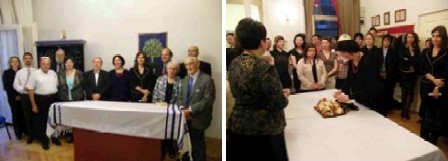
Now it's our turn to have a place to welcome them to visit us!
02 August 2010
Drop that Ease(y) Button!
In his almost weekly 77% Weekly, my colleague, Rabbi Brian Zachary Mayer (whom I have oft-quoted), the spiritual leader of the Religion Outside the Box community, offered the following essay for this week
It disturbed me and, since I was not at ease, I felt compelled to respond:
Dear RABZAM,
It disturbed me and, since I was not at ease, I felt compelled to respond:
Dear RABZAM,
I'm afraid that I have to offer a different interpretation. A mind at ease is not a good thing; it is dead. We are human beings, we live by our curiosity - that is what brought us down from the trees. I am a progressivist, I am not looking for life to go backward to a simpler time, I am looking to make the world a better place for all. While I understand the use in tempering desire before it becomes unattainable (or unhealthily attainable) lust, I believe that unrest is what drives us to improve the situation not only of ourselves, but hopefully, of others. How can I be at ease, when there are people starving down the road (be it for food, health care, education or opportunity)?
There is a nice prayer from the new Mishkan T'filah (adapted from a reading by Mitchell Salem Fisher) in the Shabbat evening service, which says, in part, "Disturb us, Adonai, ruffle us from our complacency; make us dissatisfied. Dissatisfied with the peace of ignorance, the quietude which arises form a shunning of the horror, the defeat, the bitterness and the poverty, physical and spiritual, of humans... Disturb us, O God, and vex us; let not your Shabbat be a day of torpor and slumber; let it be a time to be stirred and spurred to action. (MT, p.173)
When I look to moderate my discontent, to make it possible to be satisfied with my life, I turn back to the words of Rabbi Tarfon from Pirke Avot (which you have quoted before) - "It is not our responsibility to complete the work". But, he continues, "Neither are we free to let it rest."
(Rabbi Mayer's article is below, for those who cannot follow the link above:)
19 July 2010
Subscribe to:
Posts (Atom)